

Mountain Ash
fall berries
Mountain Ash
Mountain Ash
it only takes one cold, wet day in August to remind us that summer’s end is near.

This past week end, we attended the Kenora Harbourfest and participated in the Classic Car Show with our ’69 Camero. I took lots of pictures of parts of cars so don’t be watching future posts for shots of the 100+ cars on display. I focussed on (pun intended) wheels, chrome reflections and classic detailing. One of my favourite vehicles was a 1936 Ford pick up with this leaping greyhound which looks a lot like the iconic jaquar hood ornament. Ironically, Ford bought Jaguar in 1989. Who copied whom?
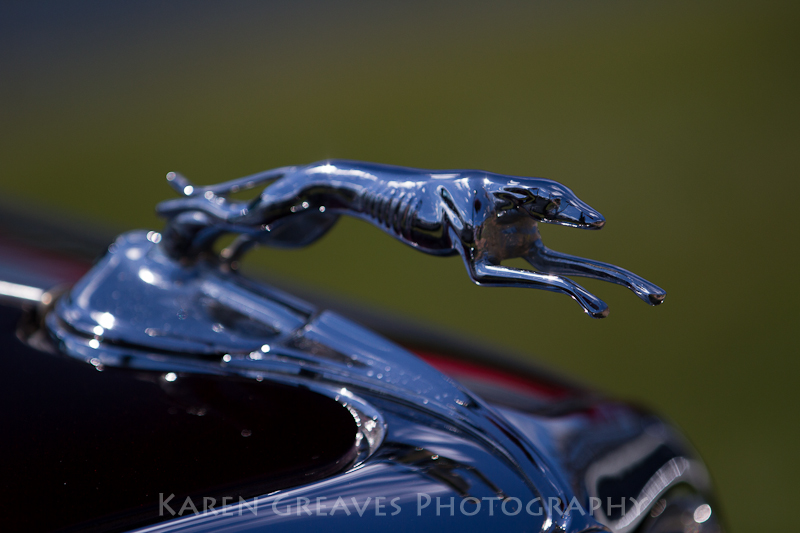
Photo tip: The amount of what is in focus is related to the aperture setting (measured in f-stops). I’ve always been confused by how this is explained, “small minimum aperture (larger maximum f-number) allows for a wider depth of field…” What I do know is the smaller the f-number, the more expensive the lense!! I have also figured out the lower number, the faster the shutter and the crisper the image. Of course this is very important with moving subjects. I usually shoot in aperture mode at the smallest number my lense will allow. What happened with the above image was, having my zoom out full (200mm) and aperture at f/2.8, only part of the ornament ended up in focus. Considering the shutter speed was 1/1250 of a second and the vehicle was not moving, I could have easily adjusted the aperture to f-11 or f-14 (is that bigger, smaller, wider, narrower, I don’t know!) Making the f-number adjustment would have brought the whole greyhound in focus. A way to remember the f-stop to use: the lower the f-number f-2.8 or f-4), the shallower the depth of field (less will be in focus) like for a butterfly on a flower with a dreamy blurred background; the higher the f-number (like f-22 or f-29) more will be in focus best for landscapes with everything in focus.
Start saving up for those sweet, pricey lenses….
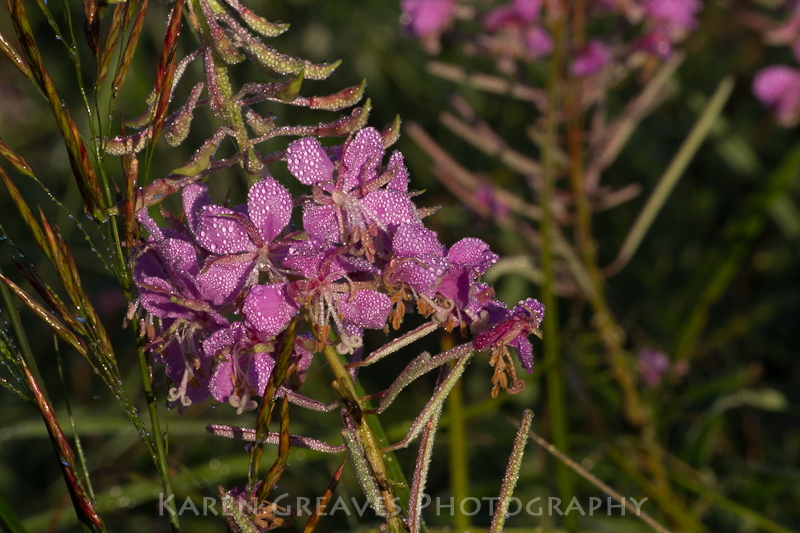
Fireweed is in bloom along the creek. The morning mist adds poke-a-dots to the petals.

While visiting friends at their cabin on Caliper Lake recently, I was able to capture the activity around their rather popular hummingbird feeder. This pair, male on the left and female on the right, took turns taking a drink. I overlaid two of the images in PhotoShop and reduced the opacity of one of the layers to give movement to image.

Photo tip: Since I didn’t have my tripod along, I used my elbow on the window ledge as one support and the front of the camera lense against the window as another.
I hope you have been enjoying the rays of sun on July’s desktop. I have more for you! This time I caught sunbeams at dawn reaching through morning mist at the creek. For specific screen resolutions, go here. I have a bonus option there, too!

It is difficult for the camera to balance the contrast between the brightness of the clear sky with the darkness of the foreground. A graduated neutral density filter can be physically added to the front of the lense to darken the sky somewhat but I did not have mine along. Fortunately, in Adobe Lightroom, where I do all my image upload, storage, rating and post-processing, there is a digital version of the graduated neutral density filter. I added a touch of darkness to the sky which brought more blue out and another digital filter to the foreground to reduce the darkness. Like seasoning your food, the amount added is personal preference. Below it a screen capture of the before and after of this process in Lightroom.

On the far right, you can see the amount of exposure compensation selected (-1.20) which is greatest at the top and fades to clear through a designated area centered horizontally above and below a selected point shown as a grey button (just to the right of the sun in the image). Like the physical graduated filter, the digital adjustment is linear. Lightroom also offers a large number of other adjustment tools. There are photographers who prefer to do as much in camera as possible and next to nothing in post-processing. I am quite happy to have come to this hobby in the age of all things digital and enjoy learning both camera and computer.
 Karen Greaves Photography & Fibre Art